
The question of which Bach flower to choose comes up often among people discovering this system of floral remedies, since a range of 38 essences can seem overwhelming at first. Unlike a food supplement classified by physical benefit, each Bach flower addresses a specific emotional state, which entirely changes how the right one should be selected.
How to identify your emotional state before choosing a Bach flower
Before making any selection, the first step is to observe what is really happening on an emotional level, rather than starting from the physical symptom or the outer situation. Someone who dreads a specific exam does not have the same emotional profile as someone who feels a diffuse anxiety with no identifiable cause, even though both might spontaneously use the word “fear”.
This observation is best done over several days, noting the emotions that recur most often rather than those tied to a single isolated incident. Dr Edward Bach, the British physician behind this system in the 1930s, built his classification on this exact principle: treating the underlying emotion rather than the event that triggers it.
Why a single flower is not always enough
An emotional state often combines several dimensions, for example a specific fear paired with a lack of confidence in one’s own ability to face it. In that case, a single Bach flower only covers part of the feeling, which is why the method allows combining several remedies in the same bottle.
Keeping a journal of dominant emotions
Some people find it useful to note, over a week, the emotions that come up most often and the circumstances that trigger them. This process helps distinguish a passing emotion tied to an isolated event from a more settled state that deserves support over several weeks. It also avoids choosing a Bach flower based on a single moment’s impression, which may not reflect the actual underlying emotional state.
The 7 emotional categories of Bach flowers according to Dr Edward Bach
Dr Bach grouped the 38 flowers into 7 broad categories of emotional states, which is a useful starting point for guiding a choice. The table below summarises these categories and the flowers most representative of each.
| Emotional category | Associated Bach flowers | Targeted emotion |
|---|---|---|
| Fear and insecurity | Mimulus, Aspen, Red Chestnut | Identified or diffuse fears, worry for loved ones |
| Doubt and uncertainty | Scleranthus, Cerato, Gentian | Hesitation between two choices, lack of confidence in one’s own judgement |
| Insufficient interest in present circumstances | Clematis, Honeysuckle, Wild Rose | Mind turned toward the past or the future, resignation |
| Loneliness | Water Violet, Impatiens, Heather | Need for isolation or, conversely, constant contact |
| Oversensitivity to influences and ideas | Agrimony, Centaury, Walnut | Difficulty asserting oneself against others or change |
| Despondency and despair | Larch, Elm, Star of Bethlehem | Loss of confidence, emotional shock, sense of failure |
| Excessive concern for the welfare of others | Chicory, Vervain, Rock Water | Control, demands on oneself or on loved ones |
This table remains a starting point: within each category, several flowers can match different nuances of the same broad emotion.
Which Bach flower to choose for fear and insecurity
The “fear and insecurity” category distinguishes several profiles depending on whether the fear is identifiable or not. Mimulus suits precise, named fears, such as fear of flying or public speaking. Aspen, by contrast, corresponds to vague apprehensions with no clear object, sometimes paired with a sense of impending danger with no identifiable reason.
Red Chestnut targets a specific form of worry: the one felt for a loved one rather than for oneself. It is often considered by people who constantly anticipate the worst for their children or their family, a mechanism that can also disrupt sleep, as detailed in the article on Bach flower for sleep.
Which Bach flower to choose for doubt and uncertainty
Doubt and uncertainty form the second broad category of the Bach system. Scleranthus is suited to people who hesitate persistently between two options without managing to decide, with an instability that can also show up physically through marked mood swings.
Cerato suits a different profile: someone who doubts their own judgement to the point of systematically seeking others’ opinions before deciding. Gentian, finally, targets the discouragement that follows a setback or a failure, with a tendency to doubt what comes next at the slightest difficulty encountered.
How to build a personalised remedy with several Bach flowers
Dr Bach’s method allows combining several flowers in the same bottle, generally within a limit of seven simultaneous remedies. Beyond that, the selection loses precision and becomes hard to interpret, which runs against the very logic of the method: targeting clearly identified emotions rather than acting in a general way.
To build a personalised blend, it is common to proceed by elimination: first identify the dominant emotional category, then refine by comparing the precise descriptions of the two or three flowers that seem to match. A structured questionnaire, often offered by specialised brands, can make this step easier by pointing toward the most relevant combinations based on the answers given.
This step-by-step approach echoes the logic already described for other targeted uses, for example when it comes to calming a temporary anxiety with an essential oil for stress and anxiety, a complementary approach that works on a different level but can be combined with floral remedies as part of an emotional wellbeing routine.
Usual dosage for a personalised blend
The most common dosage is to dilute 2 drops of each selected flower into a 30 ml dropper bottle filled with water, then take 4 drops of this blend, 4 times a day, under the tongue or in a glass of water. This frequency can be increased during periods of more marked tension, without exceeding the quantities indicated on the original bottle of each remedy.
Single Bach flower or the Rescue blend: how to decide
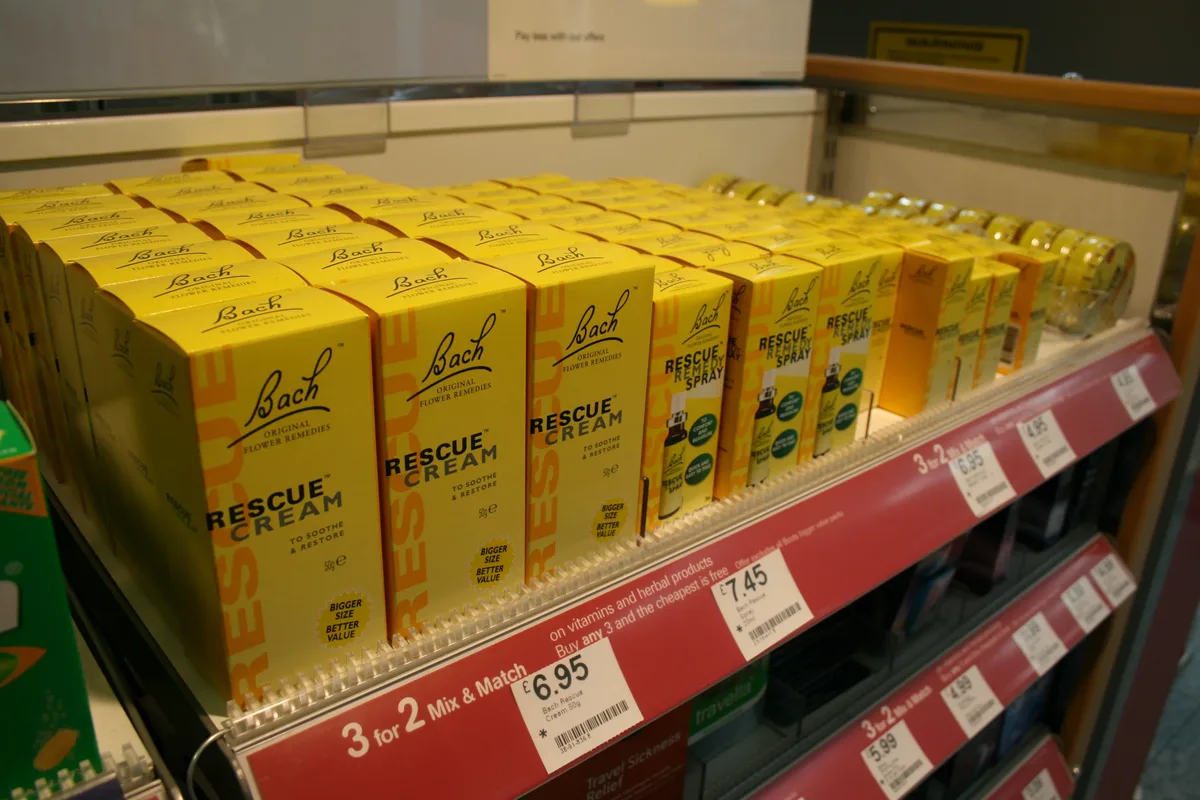
Rescue Remedy, a blend combining Rock Rose, Impatiens, Clematis, Star of Bethlehem and Cherry Plum, is the best-known blend of the Bach system, particularly suited to moments of occasional stress, and can be complemented by an individualised selection. It was designed for situations of acute, temporary shock or stress, such as an exam, a stressful unexpected event or bad news. This acute dimension is close to what is addressed when trying to calm heart palpitations naturally, where a sudden stress reaction also calls for a fast-acting response rather than a long-term one.
By contrast, a single flower chosen after precisely observing the dominant emotion allows for more targeted work over time. The choice between the two therefore mostly depends on context: Rescue Remedy for a quick response to an isolated event, one or several single flowers for more structured support, usually followed over several weeks before reassessing the blend.
Frequently asked questions
Is there a single best Bach flower?
No, the 38 remedies of the Bach system are not ranked against each other. Each targets a specific emotion, and the right one depends entirely on the state felt at a given moment. Rescue Remedy, often mentioned, is a blend of five flowers specially designed for sudden, temporary shock, which complements the individual flowers.
Are Bach flowers really effective?
No clinical study has so far demonstrated a pharmacological effect greater than a placebo. Many people nonetheless report a subjective sense of wellbeing after using them, which explains their popularity alongside other wellness approaches. They do not replace medical follow-up in cases of persistent emotional difficulty.
Can Bach flowers be given to children?
Yes, Bach flowers are generally considered suitable for children, adjusting the number of drops to their age. It is preferable to choose an alcohol-free version diluted in water, and to ask a pharmacist for advice if there is any doubt about dosage.
How do you know if you chose the right Bach flower?
A perceived improvement in the targeted emotion usually appears after a few days to a few weeks of regular use, without the immediate effect of a medication. If no change is noticed after three to four weeks, it is common to reassess the dominant emotion and adjust the selection.