
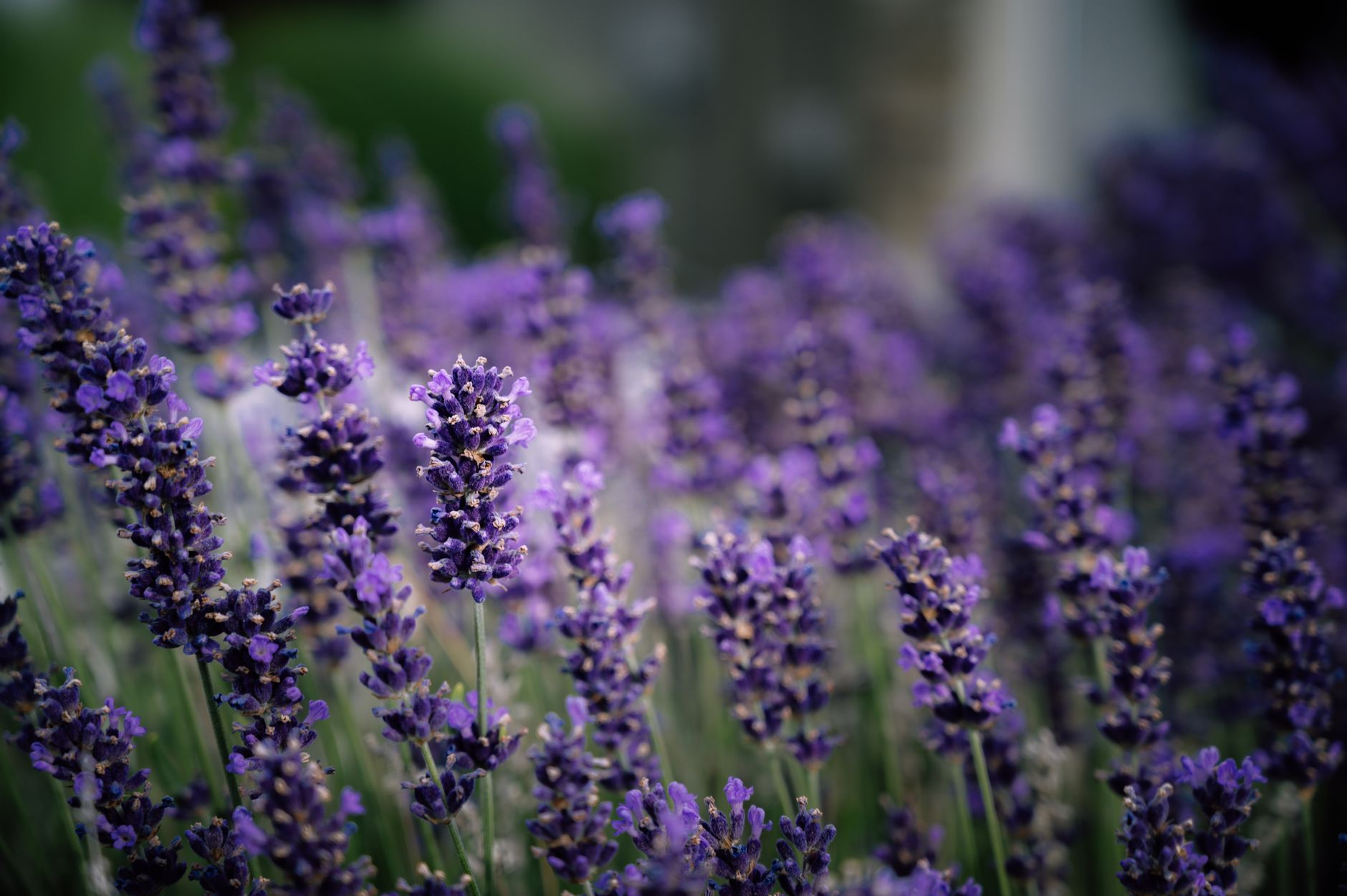
Lavender essential oil is one of the staples of family aromatherapy, valued as much for its soothing scent as for its practical uses. Diffusion, skin application, bath, or blends with other oils: it still helps to know which variety to choose among true lavender, fine lavender, spike lavender and lavandin, and in what proportions to use it depending on the need.
True lavender, spike lavender, or lavandin: what’s the difference?
Under the generic name “lavender” hide several species and hybrids with distinct properties, which are worth telling apart before choosing a bottle.
True lavender and fine lavender
True lavender (Lavandula angustifolia), sometimes sold as fine lavender, grows at altitude and stands out for its richness in linalool and linalyl acetate. This biochemical makeup gives it a gentle, well-tolerated profile, making it the only variety recommended for children from age 3. The terms “true” and “fine” broadly refer to the same plant, with slight variations in growing altitude influencing ester content.
Spike lavender and lavandin
Spike lavender (Lavandula spica) grows at lower altitudes and contains camphor and cineole, absent from true lavender. This camphorous ketone content makes it more stimulating but also more irritating: it is not recommended for pregnant women, breastfeeding women, or children under 6. Lavandin, a natural hybrid between true lavender and spike lavender, inherits an intermediate profile. Cheaper to produce, it is widely used in mainstream blends and scented household products, but remains less gentle than true lavender for close skin contact.
The table below summarizes the main markers for telling the four varieties apart before purchase.
| Variety | Botanical name | Dominant compounds | Main use |
|---|---|---|---|
| True lavender | Lavandula angustifolia | Linalool, linalyl acetate | Relaxation, skin application, sleep |
| Fine lavender | Lavandula angustifolia (altitude) | Linalool, linalyl acetate | Same as true lavender |
| Spike lavender | Lavandula spica | Camphor, cineole, linalool | Respiratory tract, occasional, not close skin contact |
| Lavandin | True x spike hybrid | Camphor, linalool, linalyl acetate | Diffusion, scented household products |
How to use lavender essential oil day to day
The choice of application route depends on the desired effect: general relaxation, targeted skin action, or sleep support.
Atmospheric diffusion
A few drops of true lavender essential oil in a cold diffuser (nebulizing or ultrasonic) are enough to scent a room and create a soothing atmosphere, particularly in the evening. A 15 to 20 minute session, repeated two to three times a day, avoids saturating the air. To precisely adjust the essential oil diffuser dosage based on room size, it helps to follow the guidelines specific to each device rather than a single rule.
Skin application, massage, and bath
On the skin, true lavender tolerates an occasional pure application on a small area (wrists, temples), but a 20% dilution in a vegetable oil (sweet almond, jojoba) remains recommended for a broader massage, at a rate of 2 drops of essential oil to 8 drops of vegetable oil. In the bath, 5 to 8 drops diluted in a neutral base (milk, honey, or dispersant) before adding them to the water avoid the irritating film effect on the surface.
For an evening massage that supports falling asleep, a few diluted drops applied to the soles of the feet or along the spine, at the end of the bedtime routine, usefully complement diffusion. This pre-sleep application remains one of the best-documented uses of true lavender, provided at least an hour passes between application and bedtime to let the scent settle slightly.
The benefits of lavender essential oil for the skin
Beyond its relaxing use, true lavender essential oil has recognized properties for the skin. Its healing and regenerating action makes it a go-to remedy for minor cuts, light burns, and insect bites, applied pure in a very small amount. It is also known for its soothing effect on skin prone to redness and irritation, often included in serums or night creams at low concentration. Its linalool content also gives it mild antiseptic properties, useful as a local treatment for minor skin blemishes.
These properties also make it a common ingredient in organic cosmetics for sensitive skin: a few drops added to a vegetable care oil (jojoba, argan) or a neutral cream make it possible to prepare a homemade soothing night treatment, provided the concentration stays under 1 to 2% for daily use on the face. Acne-prone skin sometimes benefits from its purifying action, blended with tea tree, applied very locally on blemishes.
Precautions and contraindications
Lavender essential oil, whatever the variety, remains a concentrated active ingredient that should be handled with care.
Dilution and patch test
Before any first skin application, a patch test on the inside of the elbow, 24 to 48 hours ahead, helps check for the absence of an allergic reaction. A 20% dilution is the default rule of thumb for an adult with repeated use; it rises to 50% for spike lavender, which is more irritating, and drops to 5-10% for children over 3.
At-risk groups
Spike lavender is formally not recommended for pregnant women, breastfeeding women, and children under 6, due to its content of potentially neurotoxic ketones at high doses. True lavender, better tolerated, should still be avoided orally without advice from a healthcare professional and used with caution in people with asthma, where prolonged diffusion can irritate sensitive airways.
People on anticoagulant or sedative treatment should also ask a pharmacist for advice before regular use, as true lavender may slightly potentiate the effect of certain calming medications. In pets, especially cats, prolonged diffusion is not recommended due to a particular sensitivity to terpene compounds.
How to choose your lavender essential oil
Choosing a reliable essential oil brand relies on a few simple markers: the full botanical name (Lavandula angustifolia for true lavender, Lavandula spica for spike lavender), an indication of the chemotype guaranteeing the batch’s biochemical composition, and a stated growing origin (Haute-Provence, Drôme). For versatile everyday use, true or fine lavender remains the safest choice; spike lavender and lavandin are better suited to occasional, non-close-skin uses, such as scented cleaning or diffusion blends.
Bottle format also deserves attention: a pre-diluted 10 ml roll-on suits on-the-go use on the wrists or temples, while a 10 to 15 ml dropper bottle of pure essential oil is better suited to diffusion and custom dilutions. Organic certification, while not required to guarantee effectiveness, remains a common selection criterion to limit exposure to treatment residues, as lavender is a lightly treated crop compared with other aromatic species.
Blends and storage: practical tips
Lavender essential oil blends well with other essential oils to broaden its range of action. Combined with tea tree, it reinforces the purifying action of a skin blend; combined with sweet orange or bergamot, it softens an evening diffusion aimed at relaxation; with eucalyptus radiata essential oil, it completes a winter respiratory blend; with Roman chamomile, it reinforces a soothing blend for children from age 3, at an age-appropriate dilution.
Stored away from light and heat, in its original tinted bottle tightly closed, lavender essential oil keeps its properties for 4 to 5 years after opening, compared with 2 to 3 years for the more volatile citrus oils. A bottle exposed to direct light or temperature swings gradually loses its most volatile active compounds, such as linalool, which reduces its effectiveness without the scent necessarily changing noticeably. Noting the opening date on the label makes it easy to track this shelf life.
Frequently Asked Questions
How do you use lavender essential oil to sleep better?
In atmospheric diffusion, a few drops of true lavender essential oil placed in a cold diffuser around thirty minutes before bedtime encourage relaxation. On the pillow, one pure drop is enough, or 2 drops diluted in a vegetable oil massaged onto the wrists and inner forearms.
Can lavender essential oil be applied directly to the skin?
True lavender is one of the few essential oils that tolerates an occasional pure application on a small area, for example one drop on a minor burn or an insect bite. On a larger area or with repeated use, a 20% dilution in a vegetable oil remains the safety rule of thumb, with a patch test beforehand on the inside of the elbow.
What are the contraindications of lavender essential oil?
Spike lavender essential oil is not recommended for pregnant or breastfeeding women or children under 6, due to its ketone content. True lavender, better tolerated, should still be avoided orally without advice from a healthcare professional, and used with caution in people with asthma.
How is fine lavender essential oil used day to day?
Fine lavender, botanically close to true lavender, is used the same way: diffusion for ambiance, diluted skin application for muscle relaxation, or a few drops in bath water. Its slightly different ester content sometimes makes it preferred for evening massages.
Is lavender essential oil effective against lice?
True lavender is included in many anti-lice blends, alongside mechanical combing, which remains the decisive step. Choosing a brand that guarantees the chemotype affects its effectiveness: the dedicated comparison of lavender essential oil brands for lice details the criteria to check.